
Hardware
The platforms we build and compete on
We run three robot platforms, plus a gripper we design and build ourselves.
Festo Robotino
Our competition robot since 2012, and the platform we still compete on.
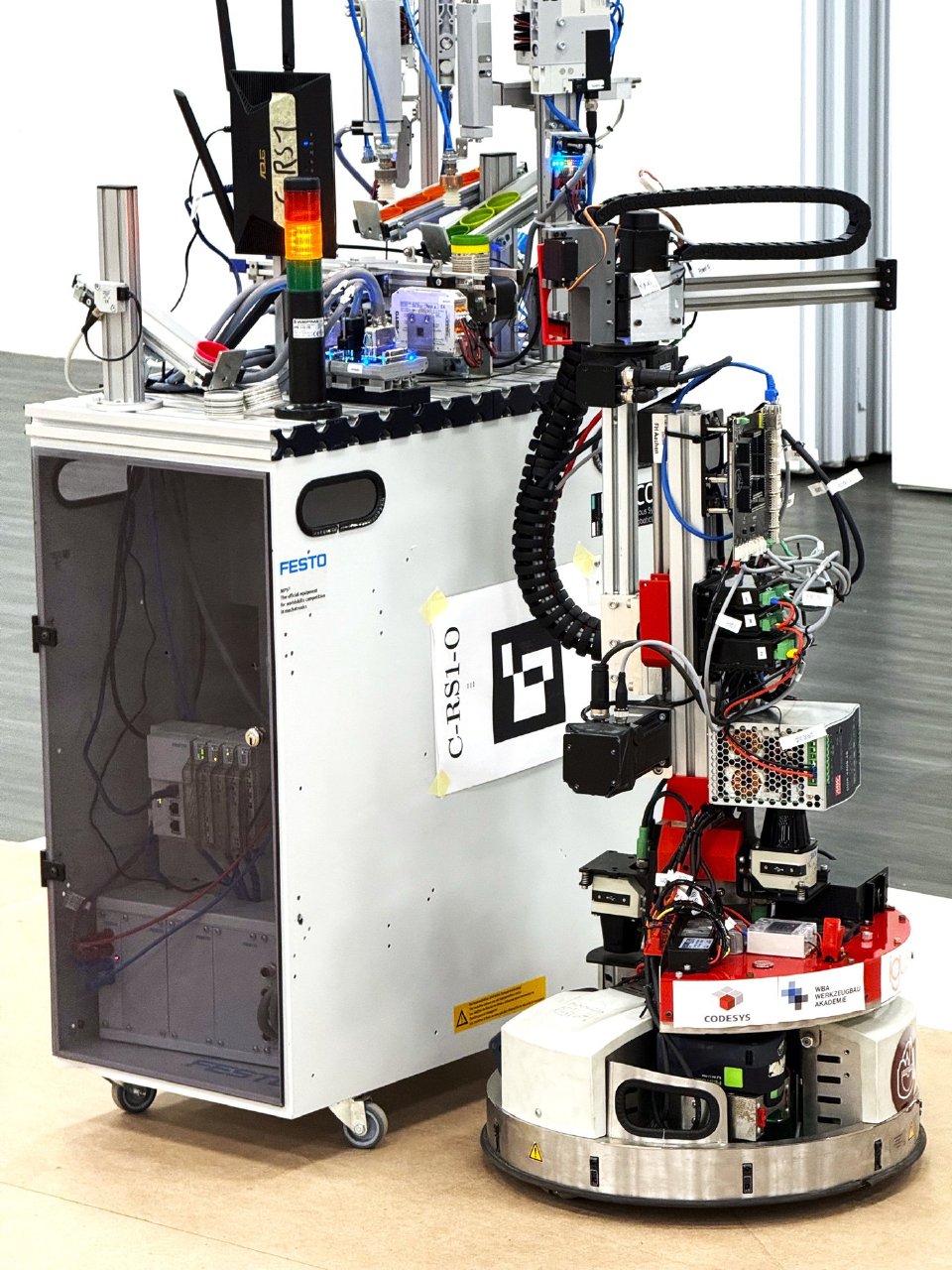
The Robotino by Festo Didactic was the standard platform of the RoboCup Logistics League. As delivered it provides an omnidirectional drive, a gyroscope, infrared distance sensors and bumpers. Everything above that we added ourselves.
For navigation we run two SICK TiM571 laser scanners, one facing forward and one facing backward, which together handle collision avoidance and self-localization. The second scanner is what makes the omnidirectional drive worth having: with a single forward-facing scanner the robot has a blind side and has to turn before it can move that way, which gives up the advantage of the base. A Raspberry Pi Global Shutter Camera picks out the points a manipulation task has to hit.
Network stability turned out to be one of the limits on coordinating several robots at once, so the robots now carry dedicated PCI Wi-Fi cards and talk to a Ubiquiti long-range access point.
Gripper
Built in-house and mounted on the Robotino.
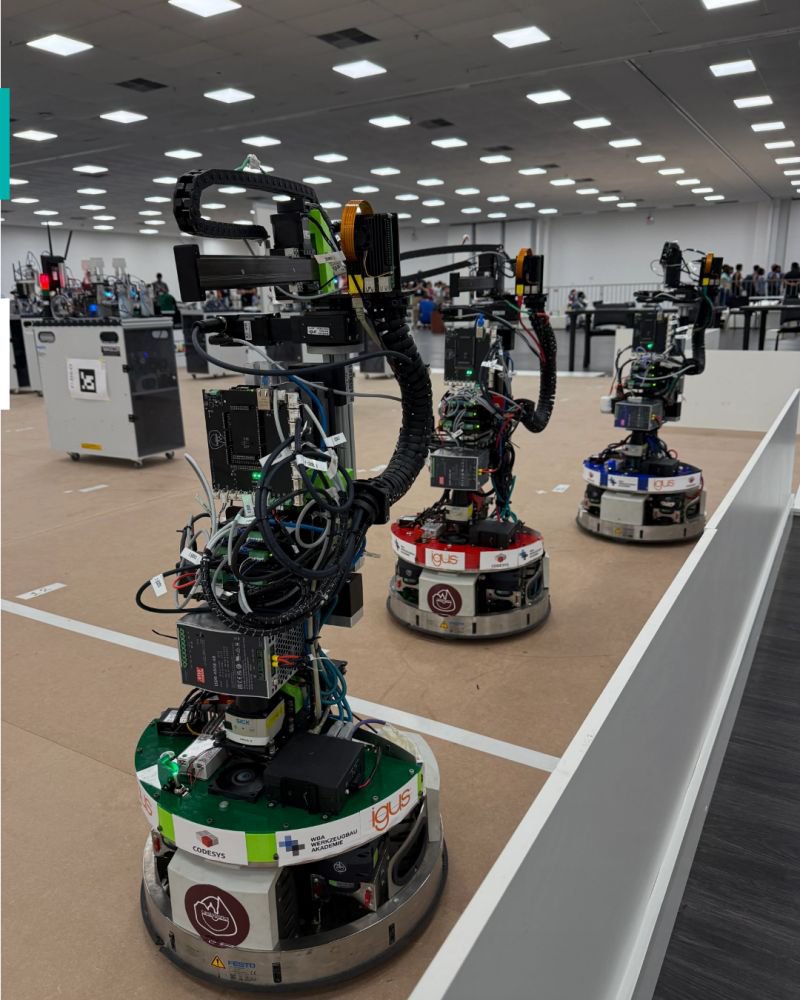
The gripper has two linear axes, one rotational axis and a single-fingered end effector. Stepper motors drive the axes, which gives us positioning accurate to under a millimetre. An Arduino Giga drives the motors and takes its commands from the Robotino’s main computer.
It grasps from above. A movable bracket pushes the workpiece off the conveyor belt against a fixed jaw, where a servo holds it. We moved to this from an earlier self-securing design because the old gripper tended to catch on the machines and the conveyor, and because the servo now acts on the bracket directly rather than through a belt.
The Smart Manufacturing League changes what has to be picked up. Next to the small parts used in the assembly tasks there are standardised Euroboxes, which differ from anything we handled in the Logistics League in both size and weight. We are redesigning the end effector around the Euroboxes first.
Universal Robots UR5
Our arm for the assembly track of the Smart Manufacturing League.
The assembly track needs a different machine from a mobile base, so we run a UR5 with a Robotiq gripper for it. Alongside it we are working with a depth camera from ifm that is still in development, which gives us the RGB-D input the assembly pipeline needs to find and pose parts it has not been trained on.
The reasoning that drives the arm, including the assembly-by-disassembly approach it uses to work out a build order, is covered on the research page.
Fourier GR-3
Two humanoids, new to the lab and not yet used in competition.
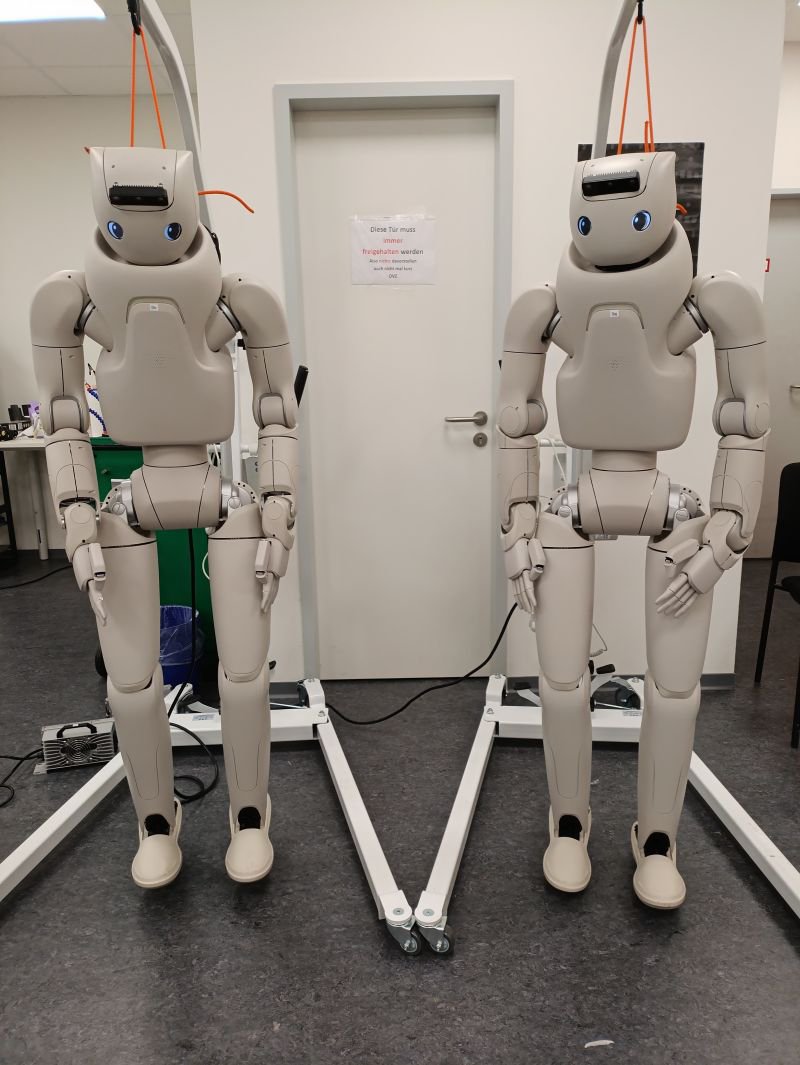
Grag and Otho are operated together with our partners at the MASCOR Institute, FH Aachen University of Applied Sciences . Part of moving into the Smart Manufacturing League is generalising a software stack written for one wheeled base so that it can also drive a very different kind of robot, and these are the platform we are doing that on.
Our hardware repository on GitHub has the technical detail, and the software page covers the stack that runs on all of this.